Performance Highlights
The four experiments and what they found. Full statistical detail is in Comparison with Centralized MaxFuse.
1. Centralized versus federated
Federated MaxFuse preserves matching geometry. FOSCTTM (\(p\)=0.35), FOSKNN (\(p\)=0.88), and all four Steadiness/Cohesiveness tests show no statistically significant difference.
It loses on label accuracy, most severely on Tonsils (\(p\)=4.57e-59), attributed to the federated implementation lacking the batching that centralized MaxFuse uses by default on that dataset.
Federated results are less stable. Even where medians match, run-to-run variance is consistently higher. Report variance alongside central tendency.
MRRE results sit in the favourable region. Both settings land in the green quadrants, meaning few missing or false neighbours. This is notable because MRRE is rank-based: MaxFuse places neighbours in close to the correct order of proximity, not merely in the right set.
2. Centralized data batching
Batching simulates a federated environment with more than two participants, where each node holds a subset of a shared feature space.
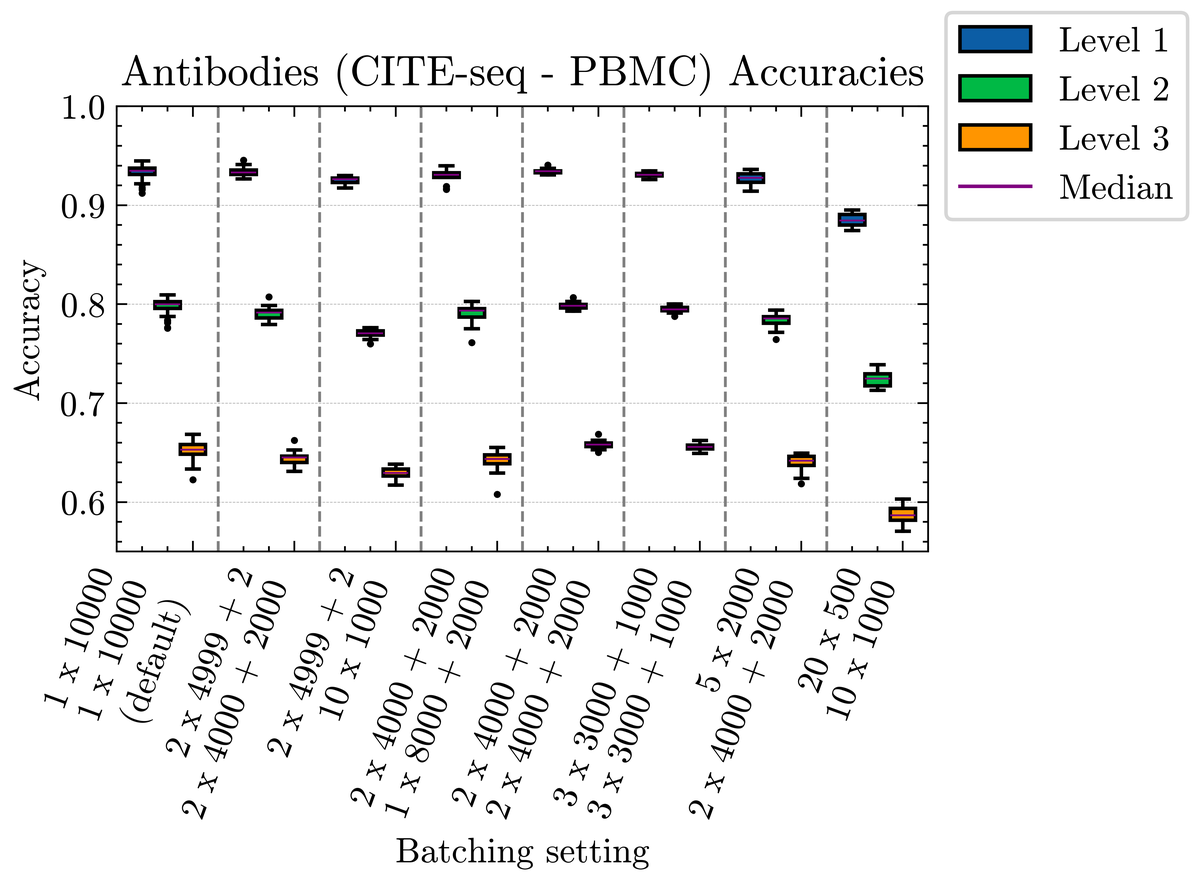
Accuracy per cell label across batching configurations. Excessive fragmentation costs accuracy.
| Finding | Detail |
|---|---|
| Moderate batching is safe | Accuracy is largely preserved when batch counts stay moderate and batch sizes stay large |
| 2–3 medium batches can help | Marginally lower FOSCTTM and higher FOSKNN — likely from reduced cross-batch embedding distortion |
| Fragmentation hurts | Many tiny batches amplify noise and fragment local structure; accuracy and clustering both drop |
| Non-batched is competitive | At these dataset sizes the default non-batched setting is among the best performers |
The practical rule: batching is viable for scaling, but batch size must be calibrated. It is not free.
3. Federated shared feature selection
How thin can the linked-feature set get before integration fails?
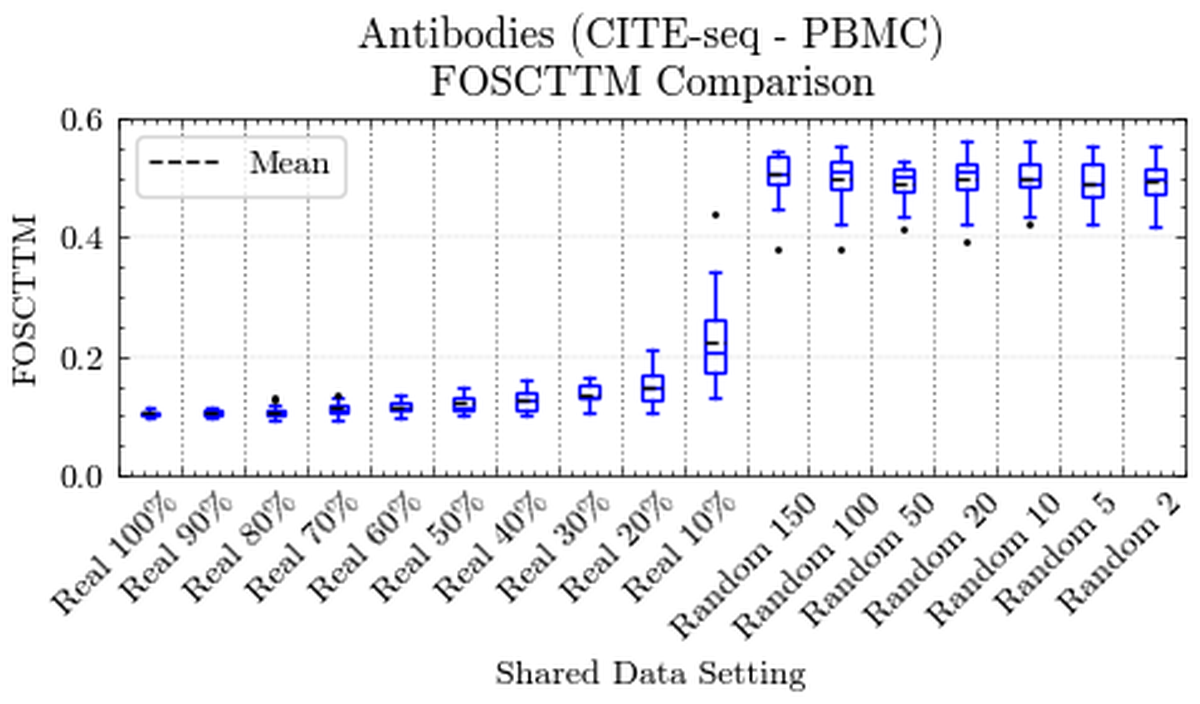
Real shared features (left group) versus randomly selected features (right group).
Two conditions were tested: using a random subset of true shared features (10–100%), and substituting randomly chosen non-corresponding features (2–150 variables).
| Condition | Result |
|---|---|
| 60–80% of true shared features | Performance near the full-set optimum |
| Randomly selected features | Severe degradation — much worse FOSKNN, much higher FOSCTTM |
The distinction is the important part. Federated integration is resilient to moderate reductions in shared information but vulnerable to the quality of what remains. Random features cannot establish meaningful initial correspondences, so canonical correlations are suboptimal and the embeddings inaccurate: the bootstrap has nothing to amplify.
Implication: the shared feature set has to be curated carefully, especially where prior knowledge of correspondences is incomplete. Comparable results remain achievable even when not all correspondences are available.
4. Random initialisation in federated CCA
The noise interpolation weight \(w\) exists so that no real data column is shared at singular-vector-power-method initialisation.
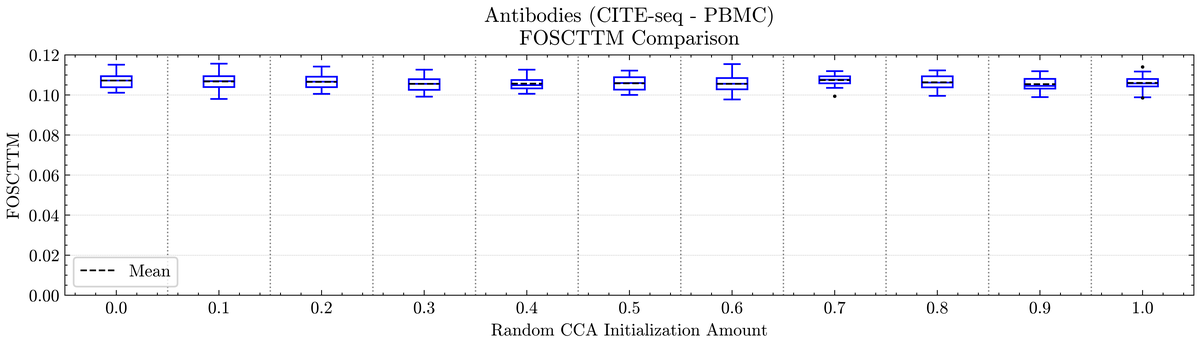
FOSCTTM across \(w \in [0, 1]\), step 0.1. The curve is essentially flat.
| Finding | Detail |
|---|---|
| Quality is stable across \(w\) | FOSCTTM varies only slightly over the full range |
| \(w \approx 0.6\) is optimal | Lowest median FOSCTTM — moderate stochasticity may help escape suboptimal convergence during singular-vector updates |
| FOSKNN likewise flat | Neighbour preservation is unaffected |
| \(w = 0\) is undesirable | It implies sharing a column of real data |
Conclusion: privacy here is essentially free. Federated CCA is robust to the randomness parameter, which reconciles privacy protection with integration quality rather than trading one against the other.
What these results support
- Federated diagonal integration of two modalities is viable: matching and embedding quality comparable to centralized on geometry-preserving metrics.
- The remaining accuracy gap is an implementation gap, not a fundamental one. Federated batching is the highest-value next feature.
- Privacy mechanisms cost little. The noise interpolation sweep is the clearest example.
- Feature curation matters more than feature count. Of everything here, this is what most changes what a practitioner should do.
What they do not support
- Any claim of formal privacy guarantees; see Security & Privacy.
- Extension beyond two modalities, which was not tested.
- Performance on datasets substantially larger than those benchmarked, where memory becomes the binding constraint.